





By Jeanni Ritchie
By the time I had my fifth child in as many years, I was quite familiar with Virginia Apgar’s work.
With each baby, my first question was “What is it?” Despite modern technology, I preferred the element of surprise — the nine-month anticipation building as friends and family made predictions. (The answer would be girl, boy, girl, girl, girl in rapid succession.)
By Baby 3, my second question came just as naturally. “What is her Apgar?”
The Apgar score is a quick, five-part check doctors and nurses use to see how well a newborn is adjusting to life outside the womb. Given at one minute and again at five minutes after birth, the test looks at heart rate, breathing, muscle tone, reflex response, and color. Each category earns zero to two points, for a total possible score of ten.
In those first fragile moments, the number gives the medical team an instant snapshot: Is baby thriving? Or does baby need a little extra help?
All five of my children were born preterm — with two needing time in the NICU — so this score was important.
Virginia Apgar was an American physician and obstetrical anesthesiologist who introduced the scoring system in 1952. At a time when infant mortality was far higher than today, her straightforward method helped delivery teams quickly identify babies in distress and respond immediately. What seems routine now was revolutionary then.
Born in New Jersey in 1909, Apgar knew early she wanted to be a doctor. She graduated near the top of her class at Columbia University’s College of Physicians and Surgeons — one of only nine women in a class of ninety students.
Despite being a woman in a male-dominated field, Apgar largely avoided women’s organizations and causes. She maintained that “women are liberated from the time they leave the womb,” and that being female had not imposed significant limitations on her medical career.
Apgar was a noted physician, author, and professor whose writings and lectures primarily focused on pediatrics and teratology (the study of birth defects). Her extensive contributions helped reduce infant mortality rates. For the last decade of her life, she served as vice president and director of basic research at the National Foundation-March of Dimes.
Her concerns for the welfare of children and families were combined with her talent for teaching in the 1972 book Is My Baby All Right? with co-author Joan Beck.
Apgar’s interests expanded beyond medicine. She traveled with her violin, often playing in amateur chamber quartets wherever she happened to be.
During the 1950s, a friend introduced her to instrument-making, and together they made two violins, a viola and a cello. The green-thumbed gardener also enjoyed fly-fishing, golfing, stamp collecting, and — later in life — taking flying lessons!
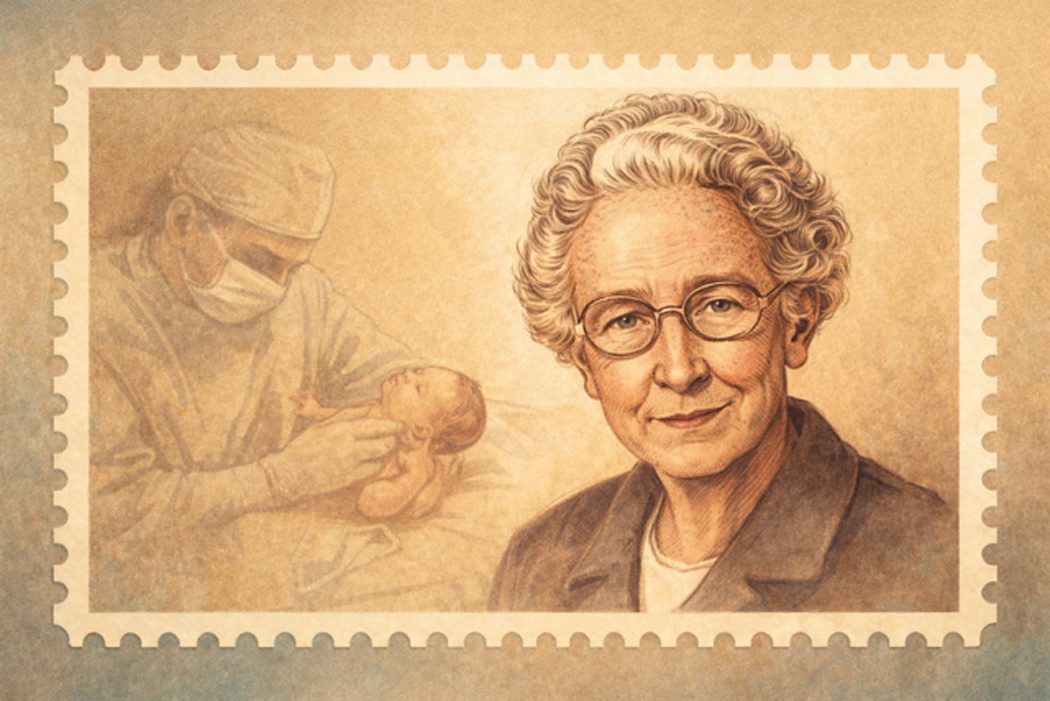
Virginia Apgar passed away in 1974, but continued to receive posthumous recognition for her contributions and achievements. Of the many nods to her legacy was a postage stamp in 1994 as part of the United States Postal Service Great Americans series.