




By Trey Cook
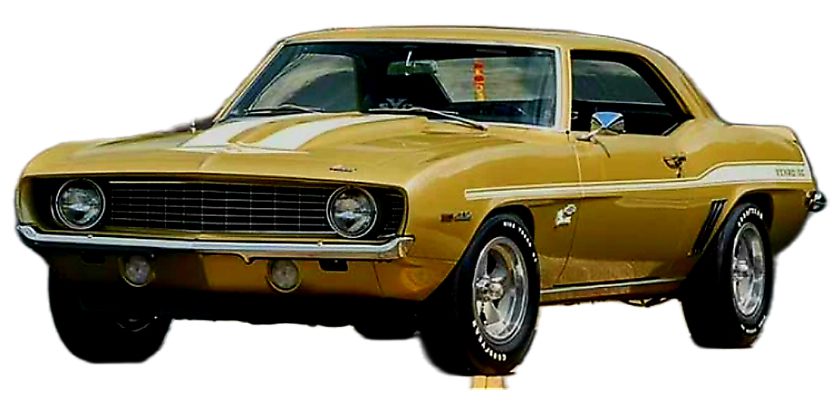
The 1969 Yenko Camaro:
In 1967 when the Camaro SS came into existence, it was quite the muscle car. But when 1969 came around Don Yenko, who had been modifying Camaros at his dealership in Pennsylvania since the moment they were born, knew he needed a new breed of Yenko Camros. The reason for this was because he heard about the brand-new Boss 429 Mustangs that were not only tearing up streets, but they dominated pro stock cars on the drag strips.
Yenko knew he had to act fast, especially for street dominance. When he got some intel on the 1969 Boss 429 from road tests, he knew that all of Chevrolet performance (including COPO) was being imminently threatened.
We are going to talk today about one of the fastest and most legendary Chevy muscle cars ever made. So, let’s get started. So, Yenko ordered 200 1969 Camaros from a very special Chevy program. They came straight from a fleet program of Chevrolet called COPO. COPO stood for central office production order. COPO made a lot of fast muscle cars including their Camaros. The reason for this was because you could order anything you wanted in these cars, if they were from COPO. That means any size or type of engine, exhaust, you name it!
Because of this reason, COPO was also known for making very quick Chevelles. But it has been very widely considered and proven that COPO was actually better known for their Chevelles, not their Camaros. The reason for this was the fact that Camaros were very light, and you couldn’t have too big an engine or else you’d have too much power to be able to control the car. You could still have a big engine if you wanted. You might have to do somethingf to add weight or change the suspension, but it would be worth it. I mean, the biggest engine I’ve ever seen in a late sixties Camaro is a 454. You can’t get much bigger than that.
The Boss 429 is a great example of this scenario, but it is a lot of work and labor to do something like this. Especially if you don’t have much experience as a mechanic. So, for this reason, a lot of guys would order Chevelles with these monstrous big block high performance V8 engines from COPO. The result was a scary, fast Chevelle.
Don’t get me wrong, the COPO Camaros were very respectable muscle cars. The COPO Camaros were commonly ordered with a 427-turbo jet. The COPO Chevelles were often ordered with a 500-turbo jet V8, so the COPO Chevelle was really quiet the upgrade from the COPO Camaro. Even though the COPO Chevelles were often quicker than the COPO Camaros, they still weren’t quicker than a Boss 9.
Yenko was bound to change that as well. The COPO Camaros, along with the Yenko Camaros, came with an iron block. He made some minor modifications in these Camaros along with new heads and pistons and push rods. They may have been what you’d call minor mods, but if you’re a true hot rodder, you will know that mods like these can give you 100 plus horsepower. There was basically no factory blueprint for him to follow when he was installing these parts. That’s what makes this car stand out from its rivals like the 1969 Boss 429, Firebird 400, Hemi Cuda and others.
What he did was neat. He did it all by himself, too. And that’s what also makes the Yenko program different from the COPO program. COPO had blueprints for their muscle cars, Yenko went completely from instinct and experience. The result was Camaro SS on steroids, aka, the 1969 Yenko Camaro. When the first ones were out and driving, he did road tests. He recorded horsepower and torque, quarter mile and 0-60 times. This car was pushing 550 horsepower and 535 ft/lb. of torque, which very much cast a large shadow on the Boss 9.
The 0-60 time was faster than the Boss, this Camaro did it in 4.80 seconds. The quarter mile was not what Don Yenko was expecting. It did a 10.90 quarter mile with slicks. He thought it was going to be right in the low tens with the Boss 9. Even though it wasn’t, he was content with the light-to-light performance. In fact, this car would often tie or slightly beat a Boss 9 in a race set up as short as a block.
Although Yenko was not happy with this quarter mile time, his Camaros were not slow in quarter mile performance. Just think about it, a street muscle car in 1969 doing a 10.90 quarter mile is insanely fast. When Don Yenko figured out Boss 9 was being beat in at least one race by these Camaros, he finally sat down and took a breath. All he wanted was the Boss 9 to be beat in one way or another.
Yenko was also known for modifying the Chevelle SS and the COPO Chevelle, and often turning it into a monster as well (but the Chevelle SS and the COPO Chevelles were already monsters before the Yenko mods).
The Boss 9 was not this Camaro’s only rival in the quarter mile or street races. Other very direct rivals of this car were, Roadrunners, Cobra Jet Mach 1 Mustangs, Hemi Cudas, GTO Judge, Firebird Ram Air 400, and some more contenders. But the biggest threat of this car was pony car muscle. Pony muscle cars were undoubtedly some of the quickest and fastest muscle cars in their time, proving my point, two of the fastest muscle cars of this time were pony cars, being the 1969 Boss 429, and the 1969 Yenko Camaro. A lot of the
mid-sized muscle cars often couldn’t be matched up with a pony car in the quarter mile. the COPO Chevelles were often the only mid-size contenders that could beat a very large majority of pony cars.
Yenko Camaros today are rare. Unfortunately, I can’t tell you how many are left. A lot of these Yenko Camaros were used in drag races in the pro stock division. There is no doubt in my mind some of these were totaled in drag races. But, on the plus side, some were not totaled in crashes.
When the early 70s came around, the insanely fast muscle cars that once ruled the streets suddenly disappeared. In other words, they were no longer being produced. Yenko didn’t do much into the 70s, Ford turned the Boss 429 into a cobra jet engine and ruined the legendary 600hp NASCAR/drag racing monster they had made. It was sad to see the end of the muscle car era.
Although, unfortunately today, there are undoubtedly less than 200 Yenko Camaros left in the world (like I said, some were wrecked in races). There is only one modern tribute to Yenko muscle. It is the 2024 Yenko Corvette. It does not have the same size engine by any means. But I find it interesting that over 50 years later, with the Camaro completely out of production, and Yenko’s once crowded and famed dealership completely abandoned and beat up, Chevy still recognized the Yenko Chevrolet muscle that once dominated streets and drag strips.
Would you challenge the legendary, 1969 Yenko Camaro? Would you ever think about owning one? What do you think?