By Robert "Bob" Bussey
Sudha Pillarisetti a trained pathologist from India emigrated to USA in 1976. His early career included professional positions in Ohio, New York, Florida, Illinois. He moved to Alexandria LA in 1989. He worked in Alexandria for 30+ years in the private sector and VA Medical Center. He is a retired American Board-certified pathologist. He lives with his wife of 45 years in Alexandria. His interests include photography, software development for laboratory use, and travel. His desire to write came to fruition during retirement and the COVID 19 pandemic.
His current publications include Fiction: ‘Tiger Wallah ‘, ‘River Wallah’, Non-Fiction ‘Me? Biopsy? OMG’. He is working on ‘Bus Wallah’. He delves in poetry reflecting his beliefs and experiences. In his words: “Fiction is the product of the brain, non-fiction of knowledge, & poetry of the heart.”
Sudha is a Pathologist, with training and education in India and USA. He retired after over 40 years of experience in pathology all over the globe. He is passionate about his profession and introduced new technologies in the laboratory and was instrumental in bringing many of those to CenLa. His interest in computer applications in the clinical lab led to many software applications including “Document Control’ for lab use. He has authored & presented many scientific papers. It is his love of writing that he decided to pursue his passion to write after his retirement. He lives in Alexandria Louisiana with his wife Amarjit (Amy).
Sudha deals in some classical forms of poetry as well as in free verse. Some of his poems are about nature, some are about earthly ills, some are about his grandchildren, and some are philosophical.
The first poem we discussed was an Ode. The Ode is one of the oldest of the classical forms of poetry. It originated in Ancient Greece. It is credited to early Greek lyric poets such as Alcman (7th century BCE), who introduced the strophic arrangement, and Stesichorus (7th–6th century BCE), who developed the triadic structure later perfected by Pindar in the 5th century BCE. Poets such as John Keats (“Ode on a Grecian Urn”) and Percy Bysshe Shelley reimagined the ode as a deeply personal and philosophical form. Today, odes can be formal or casual, celebrating anything from lofty ideals to everyday objects. The Ode celebrates something, whether animate or inanimate. The Ode created by Sudha is purely about a tiger, how it acts, how it is fearless. Perhaps a metaphor of brave humans? You read it and decide. Ode to a Tiger was written in 2018. Note that the poem also contains some rhyming lines and is not to be considered free verse.
Ode to a Tiger
King I am, King I am
Of this jungle I roam
Deer or hare
Fowl or Boar
I hunt and kill
To get my fill
Never because I can
Never for fun
Animals tremble and quiver
When I let out my roar
As the King I am just
But kill when I must
Size and color matter not
Of the animals I hunt
A chance to flee they get
Before I take their life
And end their strife
King I am, King I am
Of this jungle I roam.
King I am, King I am
Of this jungle I roam
Sleek and strong I am
Orange and black
The coat I wear
When I tread light
The noises take flight
Silence greets
The King of Jungle
Through the jungle I glide
Or stay put and let time bide
For the prey come to my side
With a mighty roar
Freeze it with fear
With the force of forepaw
Let the blood flow
No time to suffer
No chance to recover
I am a loner
And have no fear
King I am, King I am
Of this jungle I roam.
The poem also contains a chorus or refrain and is to me musical.
King I am, King I am
Of this jungle I roam
This refrain is repeated 3 times for emphasis of the status of the tiger in the view of the poet.
The next poem Sudha presented also falls into a classical form of poetry…”Shape Poetry.” Shape poetry is also an ancient form of poetry. Shape poetry (also called pattern poetry or concrete poetry) was first created in Ancient Greece around the 3rd century BCE, with poets like Simmias of Rhodes credited for early examples. He wrote poems arranged in the shapes of objects such as an egg, wings, and a hatchet. Later poets continued to experiment with shape poetry. Lewis Carroll’s, The Mouse’s Tale (1865), is an example shaped like a mouse’s tail. Avant-garde movements like Futurism and Dada, and poets such as Guillaume Apollinaire (Calligrammes, 1918) and e.e. cummings, expanded the form. Augusto de Campos and others formalized concrete poetry, emphasizing visual design as integral to meaning in the 1950’s. Sudha carries on a tradition that stretches back thousands of years with the use of shape poetry. So here is the poem: Spiraling Calamities/Calamity Spiral by Sudha.
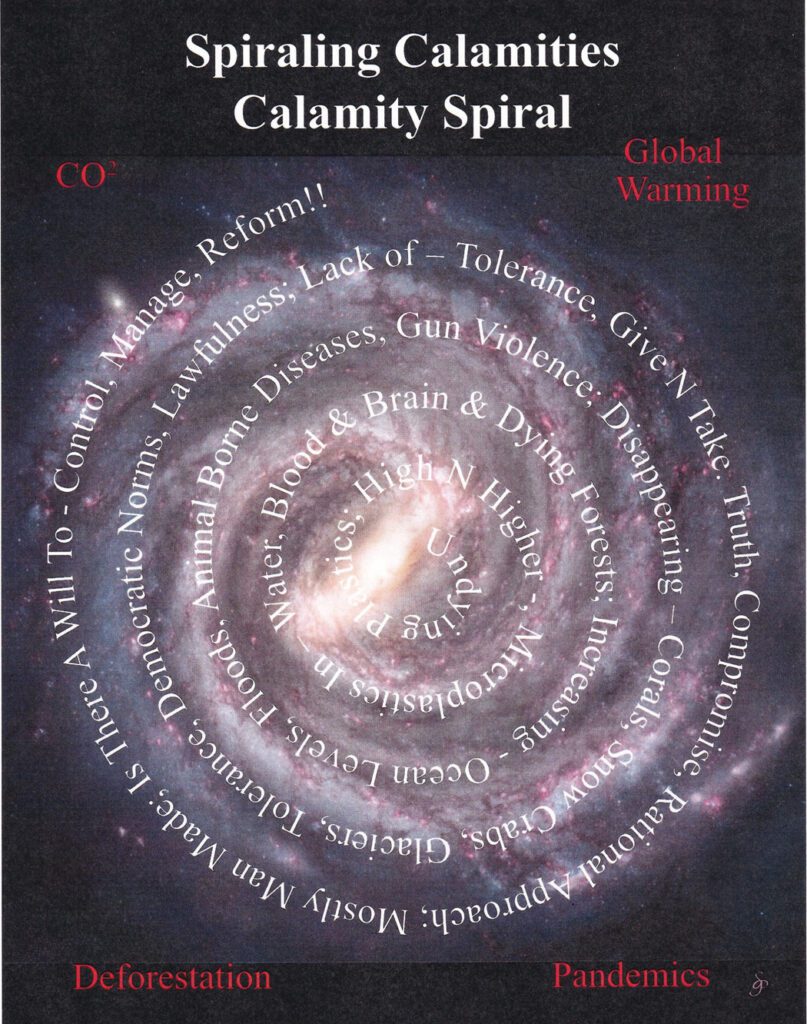
The next poem we discussed is about Sudha’s granddaughter. In it Sudha puts himself into the shoes of his granddaughter who was a mere infant, unable to speak, unable to express herself in words, just in infant sounds.
In Defence of M
I ain’t misbehavin Mama
Dada I’m not misbehavin
Can’t speak yet
For attention
I cry and scream
I ain’t misbehavin Mama
Dada I’m not misbehavin
I ain’t misbehavin Mama
Dada I’m not misbehavin
Am hungry for milk
Or something to drink
I holler and cry
I ain’t misbehaving Mama
Dada I’m not misbehaving
I ain’t misbehavin Mama
Dada I’m not misbehavin
My butt is wet
You are busy
Making an omelet
I scream and shriek
I ain’t misbehavin Mama
Dada I’m not misbehavin
I ain’t misbehavin Mama
Dada I’m not misbehavin
I want to play
You want me to sleep
Not sleepy, want to play
I have a tantrum
I ain’t misbehavin Mama
Dada I’m not misbehavin
I ain’t misbehavin Mama
Dada I’m not misbehavin
I like playing in mud
Dada you nip it in the bud
Angry and unhappy
I fuss and scream
I ain’t misbehavin Mama
Dada I’m not misbehaving.
I think many of us can envision our own children and grandchildren acting/behaving in a similar fashion. I know, I can.
Grain of Sand
I am but a grain of sand
In the vast humanity
Many greats
Recognized and
Unrecognized
Alive, Dead or
Yet unborn
Women and Men
Children too
I am but a grain of sand
Lost in the multitude
Of humanity
I am a just a grain of sand
To my mom
Am not a grain of sand
An apple of her eye
The son who
Could do no wrong
Excelled at school
Good at heart
Not a grain of sand
In Mom’s eye
Not a grain of sand
To my wife
Am not a grain of sand
A bedrock of her life
The husband who
Could and did all
Successful, loving
Not dominating
Not demanding
Not a grain of sand
In wife’s eye
Not a grain of sand
To my child
Am not a grain of sand
A pillar of strength
The dad who
Cared, loved
Taught and helped
Played and laughed
Always there
Scolded and hugged
Showed right from wrong
Not a grain of sand
In Child’s eye
Not a grain of sand
To my teachers
Am not a grain of sand
The focused student
Who did well
Never in fights
Never missed a class
Not a grain of sand
In my teachers’ eye
An ideal student
Not a grain of sand
To my students
Not a grain of sand
A teacher who taught
Questioned and challenged
Taught to inspire
Find answers yourself
Treated all with love
No favorites
But favorite of all
In students’ eye
Not a grain of sand
To my employees
Am not a grain of sand
Strict and respectful
Never a scowl or curse
Encouraged work and
Corrected mistakes
Asked and listened to
Suggestions comments
Treated all with dignity
Supported upward moves
Laughed at their jokes
In employees’ eyes
Not a grain of sand
The poem asks, are we all just grains of sand, or are we something else? What do you get as you read it? By the way, “grain of sand” is used 3 times, but “not a grain of sand” is used 14 times. So, do you think Sudha thinks he is a grain of sand or not a grain of sand?
Besides poetry, Sudha has several books that he has authored. One is somewhat technical but is written for the lay person to understand the “biopsy” procedure. It is called, Me? Biopsy?? OMG ???. If you are in need of a biopsy in the near future, you might want to read it so you can ask intelligent questions. Here is a list of his books and where they can be found:
Me? Biopsy?? OMG!!! (At Amazon) A book to explain types of biopsies, pros and cons of each, with chapters on all organ systems, types of biopsies commonly used, details of some common diseases and treatment options. Later chapters role of cancer team, TNM classification, use of new DNA studies in cancer diagnosis and treatment and what to do if something goes wrong. It is written plain English (where possible) for understanding and use by non-medical persons. It is enhanced by illustrations to complement the text.
River Wallah (At Amazon) DSP Siva known for his honesty and investigative prowess gets faces five deaths in Bombay 1970’s occuring on five consequtive Saturday nights. Everyone except Siva believe the deaths are natural. Can he prove they are murders? What can cause death that appears as natural? If they are murders how were they executed? What connects these five dead wealthy?
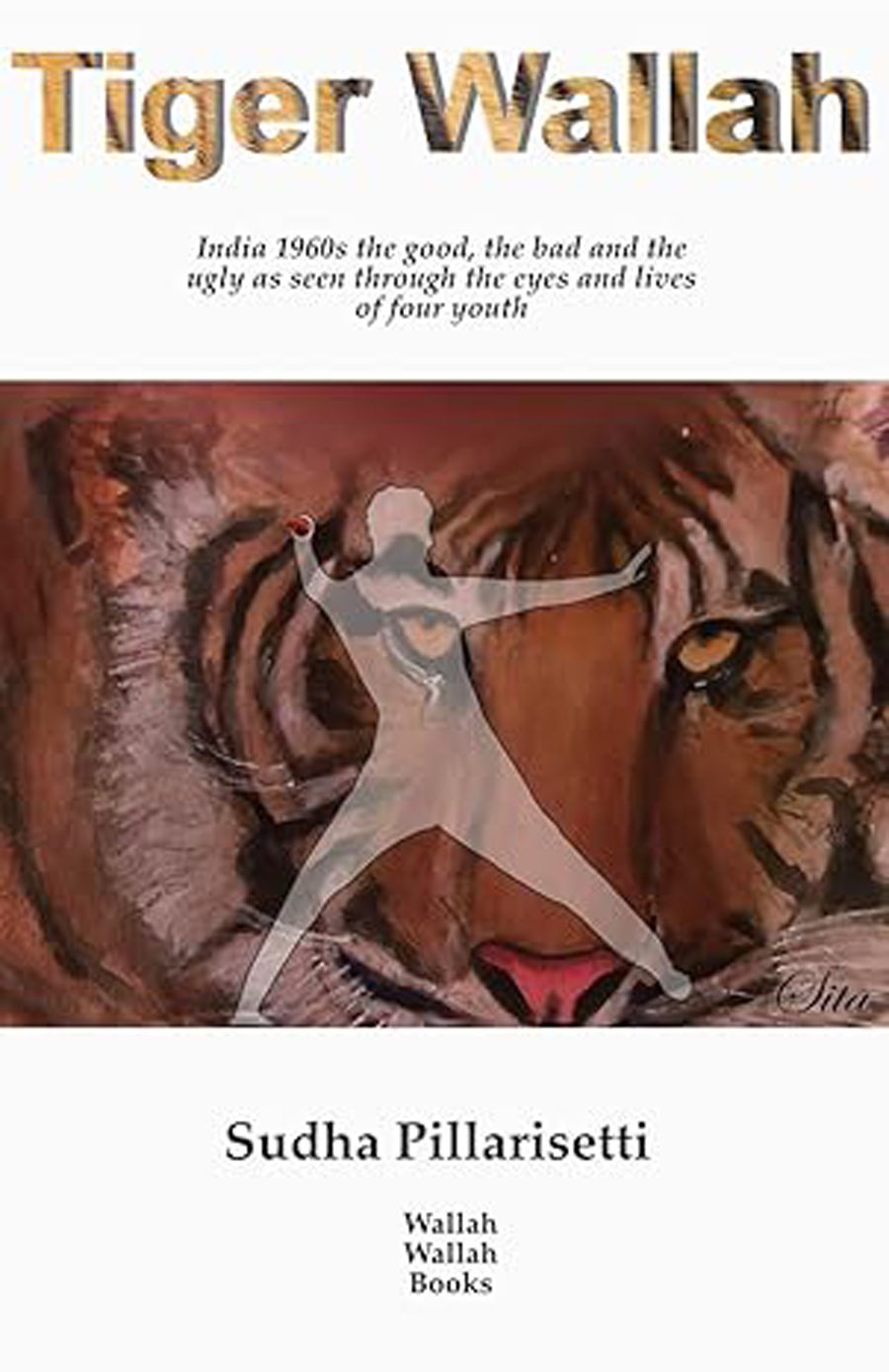
Tiger Wallah (At Amazon) India 1960s, the good, the bad and the ugly as seen through the eyes and lives of four youth. This is the story of four youngsters Anand, Vidya, Zahina and Ambika in their journey to adulthood through their turbulent lives in Southern India. At their first meeting, rich Anand resents poor Vidya. Through a series of events, they become fast friends. In college, Vidya meets Zahina a Muslim. Vidya gives up on further education after college, becomes a bank teller to support his ailing mom. He meets Ambika, the assistant manager. The lives and experiences of these four are the kernel, supplemented by colorful characters (fast disappearing) they encounter, woven into a tapestry of — love, betrayal, and redemption; innocence and malice; oppression and awakening; the strength of human spirit and fallibility; two strong young women, two not so strong young men, and above all perseverance.
Bus Wallah is a work in progress and has not been published yet.
Just search for Sudha Pillarisetti and you will find his books. His poetry has been published in the LSUA Verbatim publication. Sudha also has a web site (sudhapillarisetti.com) where you can find more about him and his works.





Robert Bussey is a local attorney and poet who has resided in CenLa since 1986. He interviews other poets and then writes these articles to help promote poetry. You can reach him at Rlbussey450@icloud.com if you are a poet and would like to be interviewed.