By Michael D. Wynne
In 1910, things were really happening in the aviation world. Walter Brookins had just set an altitude record of 4,384 feet. Charles F. Willard had won a race over William K. Vanderbilt, Jr., who wagered that he could beat Willard’s plane with his racing auto in a one-on-one race.
Central Louisianans, curious about this new fangled contraption, the airplane, decided to learn what it was all about. As a result, Jack F. Letton, then the Manager of Hotel Bentley, headed a committee which made Willard an offer of $2,000 and 60% of the remainder of the receipts after expenses to come display his flying machine and his flying skill at the old Kent addition in town, the area right behind what is now the Pentecostal Church and the VFW hall located on Rapides Avenue in Alexandria, then an open large field area devoid of trees.
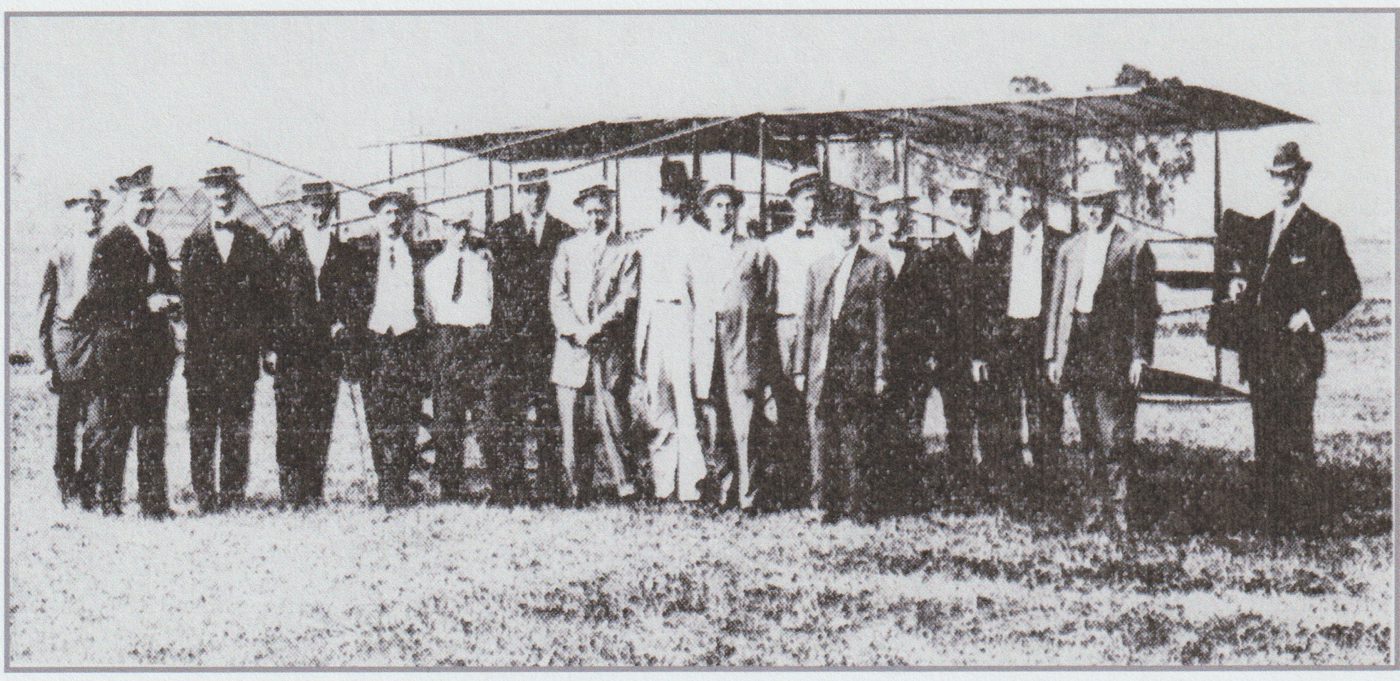
Willard and his manager, Richard R. Young, brought the “largest and fastest” flying machine in the world to Alexandria. It was a 70-horsepower, 8-cylinder, bi-plane that had been built to compete in France for the famed Gordon Bennett cup. Willard collected $3,365 as his share of the gate proceeds.
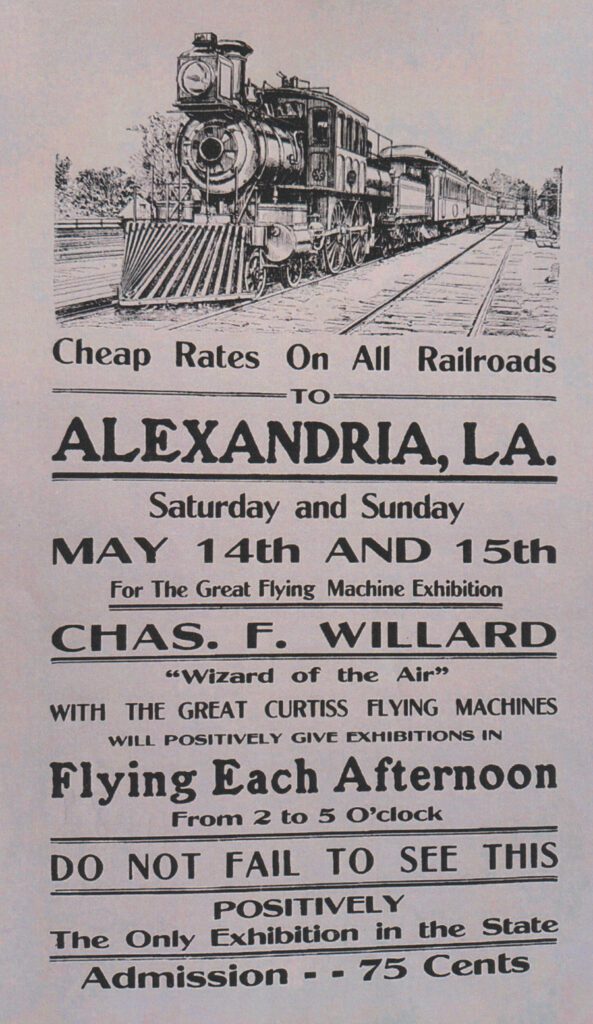
Special trains were arranged that brought spectators from Lake Charles, Shreveport, New Orleans, Baton Rouge, Monroe and other nearby cities. The event was publicized throughout the state by the Progressive League, of which local man Willard W. Whittington was president. An 800-foot grandstand to seat 5,000 attendees was built at the Kent addition for the show. The crowds that visited the city during the exhibition were unparalleled in the history of central Louisiana with people forced to sleep in tents as no hotel rooms or private homes were left available.
Willard was billed as “the wizard of the air.” He was advertised as a man of “iron nerve and fearlessness.” In addition, he was also called “quiet and refined, a Bostonian by birth and educated at Harvard.” He was then just 29 years old.
On May 14th and 15th, 1910, Alexandria was jammed with spectators who wanted to see this one of a kind exhibition. Five days before the aviator came here, Halley’s Comet was visible and local people wondered if this was the beginning of the end of the world. When Willard’s plane buzzed low over the grandstand at the Kent addition, many people knew it was the end of the world.
The Town Talk article of the event said, “…During a drizzling rain, the daring aviator arose from the earth in his Curtiss biplane and sailed off to the west, veering to the left and being soon lost to the view of the wondering crowds at the aviation field. They stood with wide-eyed admiration of the prowess that made possible the mastery of the air.
“Soon the bi-plane looked like a mere speck of a lead pencil as outlined in the southern sky, returning o the aviation field. It grew larger and larger, and finally the full outline came to view, and as quick as though it was seen to bear down on the crowd in the grandstand, coming with a mighty whirr and swish, sailing just above the heads of the people. They involuntarily ducked their heads, although the big white winged bird was 75 or more feet high …”
Willard, the 10th person ever to receive his pilot’s license in the world, never returned to Alexandria. He died unmarried in Glendale, California in 1977 mostly forgotten about and is buried in an unmarked grave in the Bronx, New York.