By Trey Cook
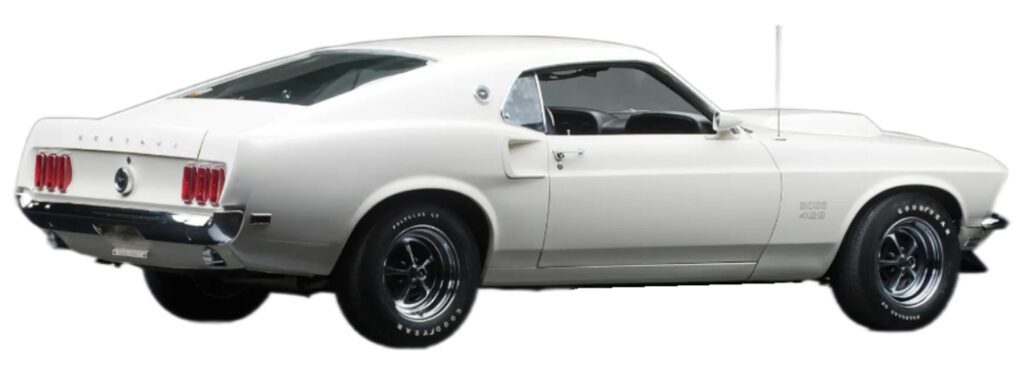
The 1969 Boss 429 Mustang
When we think of the 1969 Boss 429, words like NASCAR, high revs, and street racing come to mind. But drag racing only comes to mind if you’re a true Boss 9 guy like me. Many people do know about the drag strip capabilities of this car, but when it comes to Mustangs and Mustang enthusiasts, bad rumors about drag strip struggles have choked out people’s interest in the Boss 9. But, the people who think this car struggles in drag races, also admit that it’s not slow in a drag race either. In fact, many of these people say it runs a respectable quarter mile time. But they still say it’s not the best. Many of these bad rumors were started by the Cobra Jet fans. Proving every bad rumor wrong, it’s actually quite the muscle car. It’s got a big block hemi with lots of power and torque for drag racing, but it’s also got a high revving NASCAR nature to it. The Boss 9 really has two sides. It’s a very different quarter mile muscle car. We are going to talk about those two sides and the story of this car.
THE STORY:
In 1968, Ford debuted an engine for NASCAR to dominate the Plymouth Superbirds with the 426 hemi. The result was the Boss 429. This engine revved all the way to eleven to twelve thousand RPM. The engine dominated Plymouth in NASCAR. The pit crews also reported how quick the Torino Talladega stock car became once this engine was put in. So, when Ford, with this thought in mind, needed their NASCAR homologation, they killed two birds with one stone. They not only met the requirement of building at least 500 units, but they also made a crazy production drag car. The result: the 1969 Boss 429 mustang. To be fast in drag races, they needed a light body. And the Torino Talladega, Ford’s stock car, didn’t make the cut. It was aerodynamic and wasn’t slow either, but it was too heavy for pro stock drag racing. But don’t get me wrong, the Torino GT and street Torino Talladega are not slow, but the car to go with, for drag racing, is something lighter. And the Mustang was the best option.
PROVING BAD RUMORS WRONG:
Boss 9s began being seen more and more on streets and drag strips. And they dominated. People will try to tell you that the 1969 Boss 429, was not the quickest in a light to light drag race or the quarter mile. But this simply is not true. Guys who have driven these cars hard have said they are faster than Yenko. Which is very, very impressive. And I will tell you why. The Yenko Camaro was one of the fastest muscle cars in existence. Basically, before the Boss 9 came around in 1969, the Yenko Camaro had no rivals. The 1969 Boss 429 had one of the quickest 0-60 times of 4.9 seconds. And with drag slicks and a decent driver, this car was known to run the quarter mile in the low ten second range. But without slicks, that’s when you see this car doing a mid 11 to high twelve quarter mile. And it’s because this car had so much power and torque, that even the goodyear street racing tires slid ON the line and caused the car to lose 1-2 seconds. And a muscle car doing a low ten second quarter mile in 1969 with slicks, that was what guys called insanity.
And by the way, a low ten quarter mile is faster than what a lot of modern muscle cars do. For example: the 2025 Dark Horse Mustang was rated at 500 horsepower and 418 ft/lb of torque, and was clocked at a 12 flat quarter mile, not a low ten. The 1969 Boss 429 was factory rated at 375 horsepower with 440 ft/lb. of torque. But people soon figured out this was a major lie from Ford to get the car insured so they could race the Torino in NASCAR. People did accurate dyno runs of their own with this car and always recorded the car exceeding way past five hundred horsepower. Shockingly, the most accurate rating guys have gotten is 600 horsepower, with 540 ft/lb. of torque, way more than Ford claimed. If I could go back in time just once, I would go back just to see the looks on Kar Kraft’s mechanics faces when they did dyno runs with these cars.
People talk about the carburetor and the exhaust being restrictive on a Boss 9. The only one that was actually restrictive out of the two, was the exhaust system. The Boss 9 had a Holley four-barrel 735 CFM carburetor, do you call that a small carb? NO!!! That’s a big carburetor!! The dual exhaust system Ford had for the Boss 9 was almost like a glass pack setup. It was smaller than others you’d see on a Chevelle or Roadrunner, but it worked great for the car, and it still performed great on the drag strip. And, they also had to restrict some of the horsepower somehow to keep it a street legal muscle car. So, the way they did this was through the exhaust. Because on the NASCAR tracks, this engine made close to 850 horsepower, which was not street legal at that time for a muscle car.
I talked about the car having a second side to it in the beginning of the article. The Boss 9 may have been a crazy fast quarter mile muscle car, but at the heart of the car was, indeed, a NASCAR bred engine. When guys roll down the highway with a Boss 9, they all report that this car is not happy at a steady 4,000 RPM. The car wants to be at 8,000 RPM. They also talk about the car being at a steady 4,000 or 5,000 rpm. And out of nowhere, the engine runs faster on its own and sooner than later, the engine is trying to go faster, and you have to take your foot off the gas. This car also excelled in a race that started on the highway at 45-60 mph, and it was because of this reason: it was powered by Ford’s NASCAR ENGINE.
Today we can see Boss 9 DNA in modern Mustang engines, such as the 5.0, 5.0 Coyote, and the 5.2-liter code red. The modern Mustang engines may not be hemis, but the thing that’s almost identical to the Boss 9 is the big cylinder bores, and large shotgun exhaust ports. (Only true Boss 9 guys know why they call it the shotgun hemi.) The Boss 9 may have come towards the end of an era, but it has begun a new generation in its modern Mustang descendants. In fact the new 2025 Mustang GTD has the same exhaust port design, and also has the same size cylinder bores as the Boss 9. One of the cool things about the Boss 9 is as mentioned, the modern Mustang engines have very similar designs as the Boss 9; except that the modern Mustang engines are smaller by a long shot. The Boss 9 still can be seen on drag strips, doing what it was built for, and proving every bad rumor wrong. That’s what it’s best at! It truly is a muscle car to be commended.
So, I leave you with a question. Would you dare challenge the mighty 1969 Boss 429 to a drag race? Do you still believe in the bad rumors about this car? What are your thoughts?